
The Most Dangerous Conversation You’re Not Having
Your herding breed needs surgery. Maybe it’s routine - a dental cleaning, a spay or neuter, a mass removal. Maybe it’s urgent. Regardless, your dog will be sedated, and before that happens, a very specific conversation needs to take place with the veterinary team.
If your vet doesn’t know about MDR1 drug sensitivity, or knows about it in theory but isn’t sure which anesthetic drugs are affected, your dog is at risk. Not because your vet doesn’t care - but because the combination of MDR1 and the wrong sedation protocol can cause everything from prolonged recovery to death.
I’ve talked to families who found this out the hard way. Dogs who went in for routine procedures and came out with neurological damage. Dogs who didn’t wake up. These weren’t rare events caused by veterinary negligence - they were predictable consequences of a knowledge gap that this community is fighting to close.
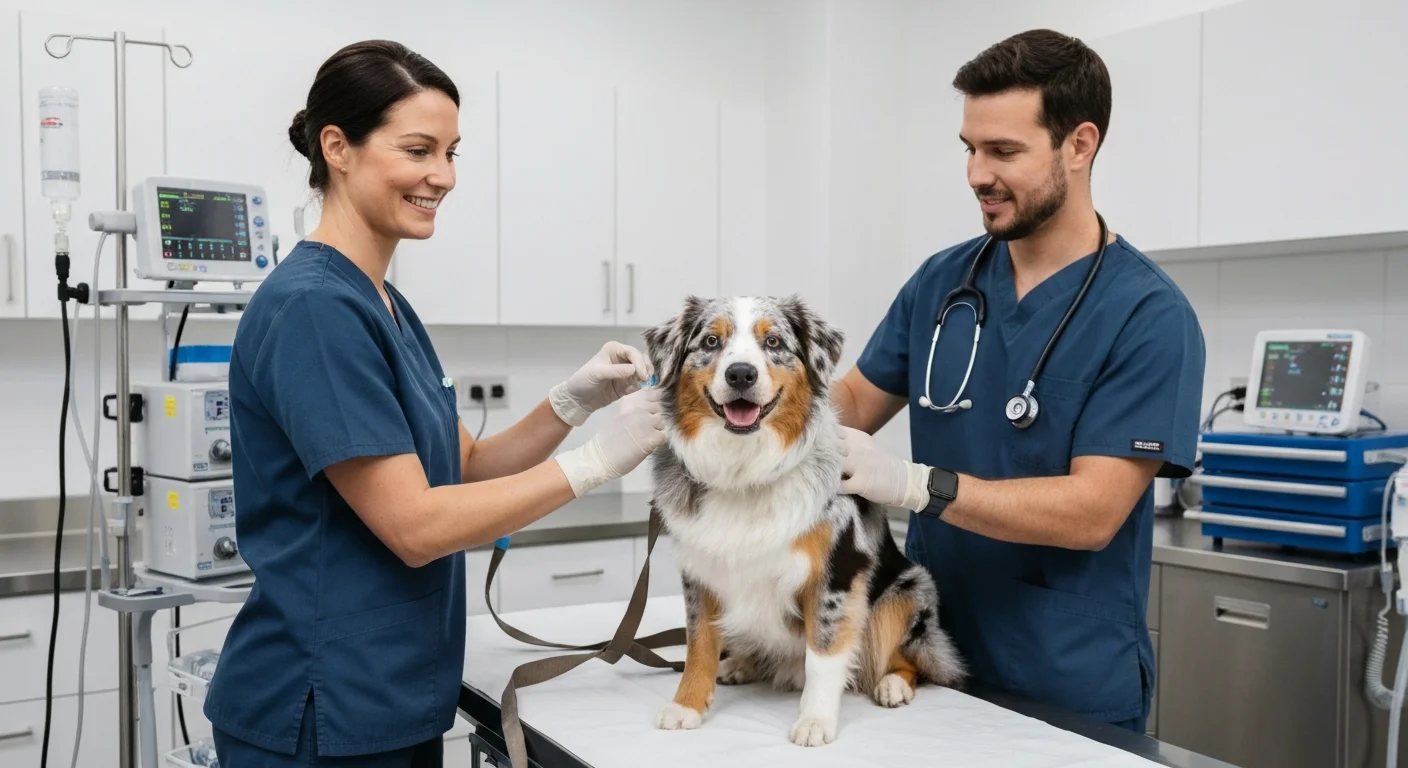
Which Anesthetic Drugs Are Affected by MDR1
Not all anesthetic agents are P-glycoprotein substrates, which is actually good news. But some of the most commonly used sedatives and anesthetic adjuncts are, and those are the ones that require modification for MDR1-affected dogs.
Acepromazine (ACP)
Acepromazine is one of the most widely used pre-anesthetic sedatives in veterinary medicine. It’s inexpensive, reliable, and most vets have decades of experience with it. It’s also dramatically more potent in MDR1-affected dogs.
Dogs with the MDR1 mutation can have profoundly exaggerated responses to acepromazine. What would be a mild sedative effect in a normal dog can cause deep, prolonged sedation, cardiovascular depression, and hypotension in a mutant/mutant dog. Recovery times can extend from hours to days. And in some cases, the cardiovascular effects have been fatal.
What to ask your vet: Whether acepromazine is in the planned protocol. If it is, ask about using reduced doses or alternative pre-anesthetic sedatives.
Butorphanol
This opioid is commonly used as part of multi-drug sedation protocols. At standard doses, butorphanol can have enhanced effects in MDR1-affected dogs. Dose reduction is typically recommended for mutant/mutant dogs.
Loperamide (if given pre-operatively for diarrhea)
Vets sometimes give loperamide to patients with GI upset before procedures. This is one of the most dangerous drugs in the MDR1 context. If your dog has diarrhea before a procedure and a vet suggests loperamide, insist on alternatives. Our guide to safer drug alternatives includes specific recommendations for this situation.
Injectable Morphine
Morphine is not typically considered a major P-glycoprotein substrate, but some evidence suggests altered pharmacokinetics in MDR1-affected dogs at higher doses. Discuss with your veterinarian.
Drugs That Are Generally Safe
This is just as important to know. Many anesthetic agents are not P-glycoprotein substrates and can be used with standard dosing in MDR1-affected dogs:
- Propofol - The most common induction agent in veterinary anesthesia. Not a P-glycoprotein substrate. Generally safe.
- Isoflurane and Sevoflurane - Inhalant anesthetics. Not affected by MDR1. Standard use is appropriate.
- Ketamine - Not a P-glycoprotein substrate. Can be used normally.
- Dexmedetomidine - Not a P-glycoprotein substrate. Standard dosing.
- Fentanyl - Some studies suggest minor P-glycoprotein interactions but clinical significance at typical doses is considered low.
The overall message: a skilled veterinary anesthesiologist can design a safe protocol for MDR1-affected dogs. The issue isn’t that anesthesia is impossible - it’s that the protocol needs to be deliberately constructed with MDR1 in mind.
The Pre-Surgical Conversation: What to Communicate
The moment your herding breed is scheduled for any procedure requiring sedation, you need to have a direct conversation - not a note left at the front desk, not an assumption that it’s in the file. A real conversation, before the day of surgery.
Here’s what to say, and what to ask:
Tell them:
- Your dog’s breed and MDR1 status (bring the test results)
- That you want the anesthesia protocol reviewed for MDR1 compatibility
- That you specifically want to know if acepromazine is included and what the plan is
Ask them:
- Who will be administering anesthesia? (A board-certified anesthesiologist versus a technician makes a significant difference for a complex patient)
- What is the pre-anesthetic protocol? (This is where acepromazine typically appears)
- What is their experience with MDR1-affected dogs?
- What is the recovery plan? (Extended monitoring is often appropriate)
If your vet seems uncertain or dismissive about MDR1 concerns in the surgical context, that is valuable information. You can ask for a referral to a veterinary specialist or teaching hospital where these protocols are more established.
Our pre-surgical preparation guide covers this in even more detail, including what to bring on the day of surgery and how to set up post-operative monitoring at home.
If Your Dog Needs Emergency Surgery
The routine surgery conversation is hard enough. Emergency surgery adds a layer of time pressure that makes it even harder to advocate effectively.
Prepare for this possibility before it happens:
- Keep your dog’s MDR1 test results in the car. Or take a photo and keep it in your phone’s camera roll. In an emergency, you won’t have time to search your email.
- Have the key information memorized or written on your dog’s medical alert tag. “MDR1 MUTANT/MUTANT - NO ACEPROMAZINE” takes up about as much space as a phone number.
- Know the nearest 24-hour emergency veterinary hospital in your area, and call them before an emergency to ask about their MDR1 protocols.
The families in our community who’ve had the best outcomes in emergency situations were the ones who walked in with information ready, who could say clearly and immediately: “My dog has MDR1 mutant/mutant status. Please check the anesthesia protocol before you proceed.”
Recovery: The Often-Overlooked Risk
Many owners focus so much on the surgical procedure itself that they’re caught off guard by the recovery period. For MDR1-affected dogs, recovery from sedation can be significantly longer than normal, and complications can emerge hours after the procedure.
Watch for these signs during recovery:
- Prolonged sedation lasting more than twice the expected duration
- Difficulty maintaining body temperature
- Unusually slow or irregular breathing
- Signs of disorientation that persist beyond the first few hours
- Ataxia (stumbling, lack of coordination) that isn’t improving
If something feels wrong during recovery, it probably is. Call the clinic. Don’t wait and see.
For a complete overview of post-operative home monitoring and when to call for help, our MDR1 testing guide includes a section on post-procedure care, and our emergency drug reaction guide applies equally to drug reactions that occur after rather than during a procedure.
You Have the Right to Ask These Questions
Some owners worry about seeming difficult or mistrustful of their vet by asking detailed questions about anesthesia protocols. Please don’t let that concern stop you.
Any vet who responds negatively to a well-informed owner asking about MDR1 safety in an anesthetic context is not the vet for your dog. Good veterinarians welcome engaged clients. They want the information you bring. And they would far rather have this conversation before the procedure than face a crisis during or after it.
Your dog cannot advocate for themselves. That’s your job. Cooper couldn’t tell Dr. Martinez that he had the mutation. I didn’t know to tell her either. You know better than I did, and that knowledge needs to be used.
This article is for educational purposes and does not constitute veterinary medical advice. Every dog is different, and anesthesia protocols should be designed by qualified veterinary professionals with full knowledge of your dog’s health history and MDR1 status. Please contact us if you have questions or want to share your experience.