
It Starts Before You Bring the Puppy Home
The decisions that protect an MDR1-affected puppy often need to be made before that puppy ever sets foot in your home. Which is why this article is written for two audiences at once: breeders who are making decisions that will follow every puppy they produce for years, and new owners who are trying to figure out what they need to know in those first critical weeks.
Because the truth is that MDR1 doesn’t start being dangerous when a dog is one year old or two years old or when they get their first prescription. It starts being dangerous the moment a puppy receives its first round of dewormers, its first round of vaccines in combination with certain drugs, or its first flea prevention treatment. Some of the most heartbreaking stories in our community involve puppies who never made it to their first birthday.
When Can Puppies Be Tested for MDR1?
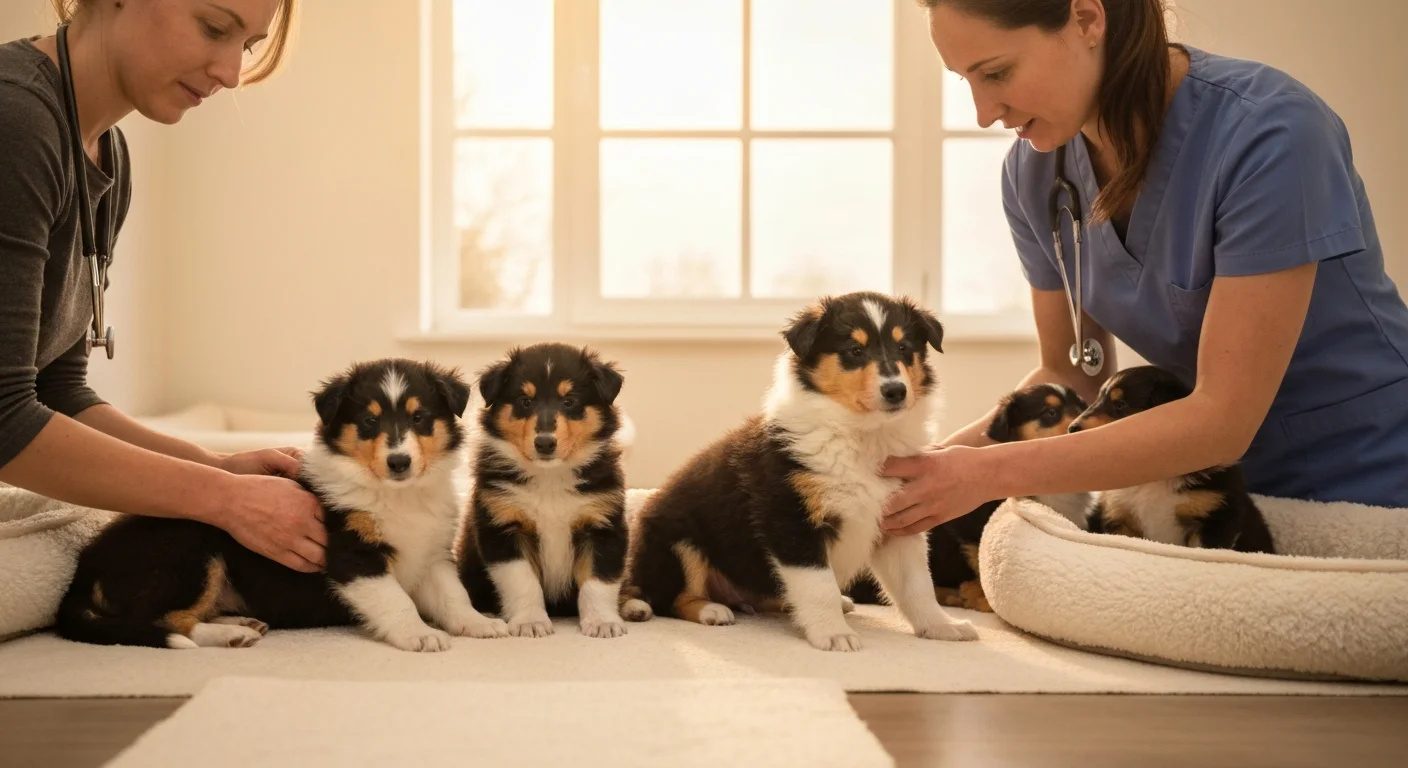
The good news is that MDR1 testing can be done at any age, including very young puppies. The test itself is a simple cheek swab - no blood draw, no anesthesia, nothing invasive. Even an eight-week-old puppy can be swabbed without difficulty.
Responsible breeders who test their breeding stock will typically know the MDR1 status of both parents. When both parents have been tested, the breeder can predict the likely genotype distribution of the litter:
- Normal/Normal x Normal/Normal: All puppies will be Normal/Normal
- Normal/Normal x Normal/Mutant: 50% Normal/Normal, 50% Normal/Mutant
- Normal/Normal x Mutant/Mutant: All puppies will be Normal/Mutant
- Normal/Mutant x Normal/Mutant: 25% Normal/Normal, 50% Normal/Mutant, 25% Mutant/Mutant
- Normal/Mutant x Mutant/Mutant: 50% Normal/Mutant, 50% Mutant/Mutant
- Mutant/Mutant x Mutant/Mutant: All puppies will be Mutant/Mutant
Even with parental testing, individual puppy testing is still valuable because it gives each puppy owner certainty about their specific dog’s status, not just a probability.
Our MDR1 testing guide includes information on testing through Washington State University’s lab, Embark, Wisdom Panel, and other providers - all of which test puppies at any age.
What Breeders Should Be Doing (And Often Aren’t)
I run a rescue and I’ve seen how inconsistently breeders handle MDR1. The spectrum runs from breeders who test every breeding dog, share individual puppy results with every buyer, and provide detailed written guidance - to breeders who have never heard of the mutation and hand over a puppy with nothing more than a vaccination record.
What responsible breeding looks like, specifically for MDR1:
Test the Parents
Every herding breed used for breeding should be tested for MDR1 before any breeding decision. Results should be a matter of record. This isn’t optional for breeds where the mutation is prevalent. It’s the ethical baseline.
Test the Individual Puppies
Parent testing tells you probabilities. Individual testing tells you certainties. When a family is taking home a puppy who will receive medical care for the next 12-15 years, they deserve certainty.
Provide Written MDR1 Guidance with Every Puppy
Every puppy going home should come with written documentation that includes:
- The puppy’s MDR1 test result
- A brief explanation of what it means
- A copy of the medication danger list
- Instruction to inform every vet they ever see
The information doesn’t need to be elaborate. A single printed page would have saved Cooper’s life if someone had handed it to me when I brought home my first Collie.
Make MDR1 Status Part of the Adoption Contract
Responsible breeders include MDR1 disclosure in their purchase contracts and require buyers to acknowledge they’ve received and understood the information. This isn’t about liability - it’s about making sure the knowledge actually transfers.
The First Year: High-Risk Moments for Puppies
The first twelve months of a puppy’s life involve more veterinary interventions than most subsequent years combined. Vaccinations, deworming, flea and tick prevention, spay or neuter surgery - all of these happen in rapid succession, and all of them carry MDR1-related considerations.
Deworming
Puppies are routinely dewormed with pyrantel pamoate, which is not a P-glycoprotein substrate and is safe for MDR1-affected dogs. The danger comes when vets or owners turn to Ivermectin-based dewormers, or when “multi-parasite” products include milbemycin or moxidectin at treatment doses (higher than prevention doses).
What to check: Look up the active ingredient in any dewormer. Pyrantel pamoate, fenbendazole, and praziquantel are safe options.
Flea and Tick Prevention
Some flea and tick preventives contain Ivermectin or related drugs. Avoid these in MDR1-affected puppies. The isoxazoline class (NexGard, Bravecto, Simparica, Credelio) is not a P-glycoprotein substrate and is appropriate for MDR1-affected dogs.
What to check: Know the active ingredient. Ask about isoxazoline-class products as your first choice for MDR1-affected puppies.
Spay/Neuter
Most herding breeds are spayed or neutered in their first year. The anesthesia considerations covered in our sedation and anesthesia guide apply to puppies as much as adult dogs. Acepromazine is the primary concern. Make sure your vet knows the MDR1 status before any procedure.
Heartworm Prevention
For puppies starting heartworm prevention, our article on heartworm prevention and MDR1 explains which products are safe at prevention doses and which require more careful consideration.
For New Owners: What to Do in the First 48 Hours
If you’ve just brought home a herding breed puppy, here’s what needs to happen right away:
1. Find out the MDR1 status. Ask the breeder if individual testing was done. If not, order a test kit immediately. You don’t need to wait for your first vet visit - you can swab at home and mail the sample.
2. Call the vet before the first appointment. Tell them you have a herding breed or herding mix and you need MDR1 to be part of the conversation at every visit. Don’t assume they’ll bring it up. Many won’t.
3. Start your “danger list” habit now. Get the list of drugs that are dangerous for MDR1-affected dogs and put it somewhere you’ll always have access to it - your phone, your car, your wallet. For a complete list and what to do about each drug, our vet visit checklist is a good starting point.
4. Tell everyone who might take the puppy to the vet. Partners, family members, dog sitters, dog walkers - everyone who might ever find themselves at a vet clinic with your puppy needs to know the basics. “This is a herding breed, they may carry MDR1, please check any medication before administering.”
When the Breeder Didn’t Test
You’ve brought home a puppy. You’ve asked about MDR1. The breeder has no idea what you’re talking about, or says they don’t believe in the testing, or says their dogs have “never had any problems.”
This happens. It’s frustrating. It’s also a reality that many families face.
What you do is test the puppy yourself, immediately. Order a kit from WSU or Embark or Wisdom Panel. Have the results before the puppy’s second round of vaccinations. Don’t wait to see if your vet mentions it. They likely won’t.
And if you’re in this situation - if you’ve come to this site because your puppy came from a breeder who didn’t test, who didn’t inform you, who handed over a herding breed without MDR1 guidance - please share your story with us. We hear from families in this situation all the time. You’re not alone, and your experience can help us convince other breeders to do better.
The Goal: A Generation of Tested Dogs
The MDR1 mutation is not going away. It’s too prevalent in too many herding breeds to breed it out without causing serious genetic bottlenecks. But we can reach a point where every herding breed owner knows their dog’s status from day one, where every vet visit starts with that information in the file, where no puppy dies from a drug that should never have been given.
That future requires breeders who take this seriously. It requires puppy buyers who ask the right questions. It requires vets who know what to ask. And it requires communities like this one, sharing information and making it impossible for anyone with a herding breed to stay uninformed.
If you’re a breeder reading this, please start testing. If you’re a new owner, please test your puppy. And if you’re not sure what to do next, contact us. This is exactly the kind of question we exist to help with.
This article reflects the experiences of families and the current scientific understanding of MDR1 genetics. It is not a substitute for veterinary advice. Individual circumstances vary. Always work with a veterinarian who is familiar with MDR1 pharmacology to make medication decisions for your specific puppy.