
The Danger Beyond the Exam Room
Most MDR1 conversations focus on the vet’s office. That makes sense - that’s where most dangerous drug prescriptions originate, and the consequences of an uninformed prescribing decision are severe.
But there’s a category of MDR1 risk that often goes unaddressed: the people who care for your dog outside of the veterinary context. The boarding facility where your dog stays while you travel. The groomer your dog sees every six to eight weeks. The doggy daycare where your dog socializes during the workweek.
None of these people are veterinarians. None of them can prescribe medications. So why does MDR1 matter to them?
Because some of the most dangerous drugs on the MDR1 list are available over the counter. Because some boarding facilities and groomers use flea and parasite treatments as part of their services. Because someone at a daycare might give your dog a Benadryl for anxiety without thinking, or offer an Imodium pill for an upset stomach the way a well-meaning friend might. Because flea sprays used in facilities may contain pyrethrins, which while not an MDR1-specific concern, represent exactly the kind of casual medication decision that can harm a sensitive dog.
The Over-the-Counter Danger
Loperamide - sold as Imodium - is one of the most accessible and dangerous drugs for MDR1-affected dogs. It’s on the shelf at every pharmacy. It’s cheap. And many well-meaning people give it to dogs without a second thought, the same way they’d reach for it themselves after a bad meal.
At a boarding facility, if your dog develops diarrhea, a staff member might think they’re helping by giving a small dose of Imodium while they call you. They don’t know about MDR1. They don’t know that Imodium crosses the blood-brain barrier in affected dogs and can cause sedation, respiratory depression, and death. They’re trying to help.
This is why MDR1 information needs to be part of what you share with every person who cares for your dog. Not to alarm them. Not to create liability. To prevent exactly this kind of well-intentioned harm.
For more on which over-the-counter medications are dangerous and what safer alternatives look like, our guide to safer drug alternatives for herding breeds includes specific information about non-prescription drugs.
Flea and Parasite Treatments at Boarding Facilities
Some boarding facilities treat all incoming dogs with flea prevention or use environmental sprays and foggers that contain insecticides. Depending on the products used, this may or may not be a concern for MDR1-affected dogs.
What to ask before boarding your herding breed:
“Do you apply any topical treatments, flea preventives, or parasite control products to dogs while they stay here?”
If the answer is yes:
“What product do you use? Can you tell me the active ingredient?”
If the product contains high-dose Ivermectin, milbemycin at treatment doses, or selamectin (Revolution), that’s a conversation to continue. Standard isoxazoline flea products (afoxolaner, fluralaner, sarolaner) are fine for MDR1-affected dogs. Products containing pyrethrins are not specifically dangerous due to MDR1, but are still worth knowing about.
Most modern boarding facilities use topical flea products rather than injectable or high-dose treatments, but it’s worth confirming.
Grooming Considerations
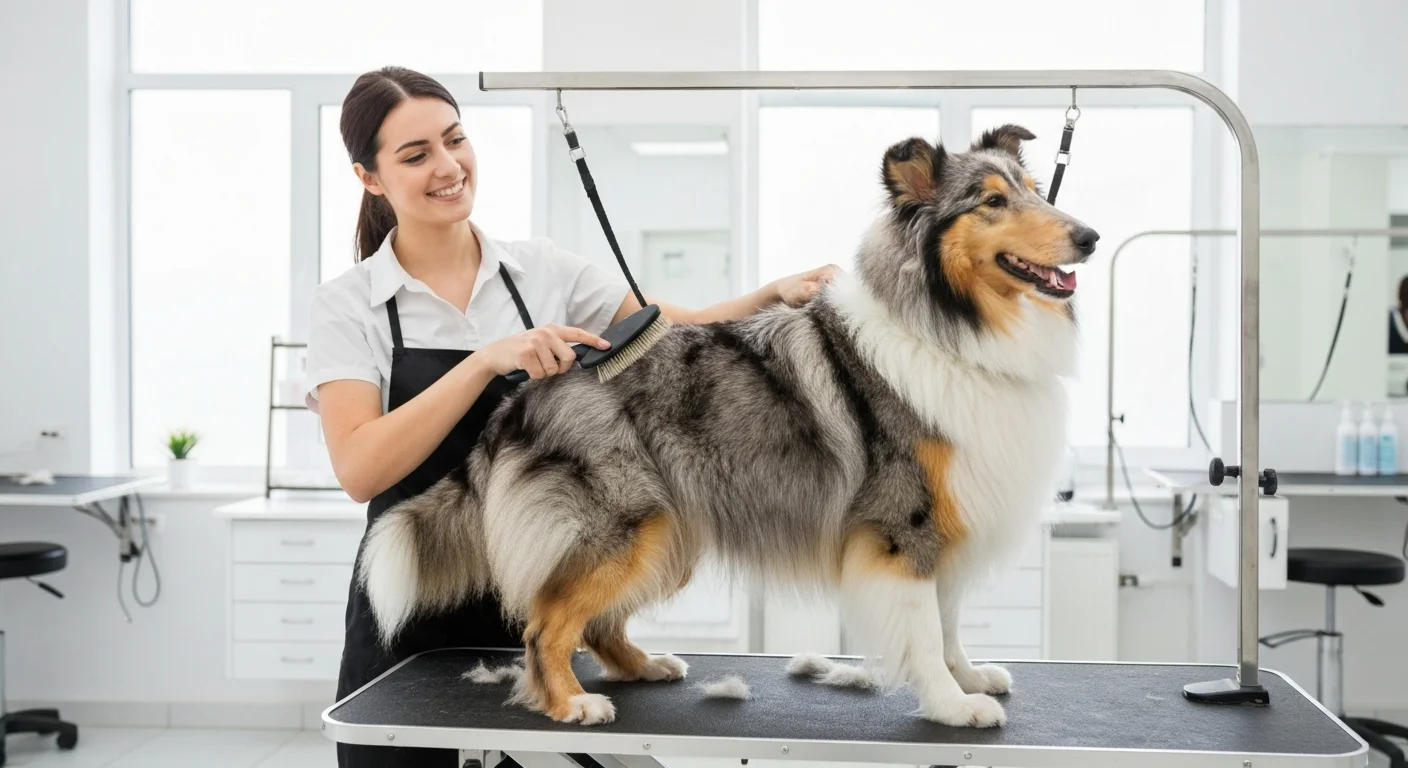
Groomers don’t prescribe medications, but they do use products that come into contact with your dog’s skin. The main MDR1-related consideration in grooming contexts is:
Flee/tick sprays and dips. Some older grooming products use amitraz-based dips or high-concentration pyrethrin sprays. Amitraz is not specifically on the MDR1 danger list (it works by a different mechanism), but it’s a potent drug that requires caution in any dog. Some groomers still offer “dip” services for dogs with parasite issues.
Over-the-counter calming products. Some groomers use or recommend over-the-counter calming supplements or sprays. These are generally not MDR1 concerns, but it’s worth knowing what your dog is being given.
Wounds and topical treatments. If your dog has a skin issue and a groomer offers to apply something to treat it, you want to know what it is before it’s applied. Well-meaning treatment of a skin problem with the wrong topical can be an issue for MDR1-affected dogs.
What to tell your groomer: “My dog is a herding breed with MDR1 drug sensitivity. If you need to apply any product to their skin for any reason beyond their normal bath and groom, please check with me first. Not all products are safe for dogs with this genetic mutation.”
Doggy Daycare and Dog Parks
Daycare staff are less likely to encounter medication decisions than boarders, but not impossible. If your dog is injured at daycare, if they develop a sudden GI issue, or if staff have the instinct to offer “something for the pain” - that’s where risk enters the picture.
The more immediate concern at daycare is your dog’s own medications. If your dog is currently on any MDR1-relevant treatment and staff need to administer medication during the day, make sure:
- The medication has been confirmed safe for your dog’s MDR1 status
- The dosing instructions are in writing
- Staff know that no additional medications should be given without contacting you first
How to Communicate MDR1 to Non-Veterinary Caregivers
Explaining MDR1 to a vet is one thing. Explaining it to a boarding facility intake coordinator is another. You don’t need them to understand the pharmacology. You need them to understand the action:
“My dog has a genetic condition called MDR1 drug sensitivity. This means certain common medications can be toxic to them, including some over-the-counter products. Please do not give my dog any medication - including Benadryl, Imodium, or any flea/parasite product - without calling me first. My dog’s life can be at risk from well-meaning medication decisions.”
Clear, specific, actionable. Most facilities will accommodate this with a note in the file and a protocol to call you before any treatment decision.
You can reinforce this with a physical tag or card. A medical alert dog tag that says “MDR1 SENSITIVE - NO MEDICATIONS WITHOUT OWNER APPROVAL” takes up minimal space and communicates the key point even if your verbal instructions get lost in staff turnover.
Preparing an Emergency Information Card
For any dog with MDR1 sensitivity, an emergency information card is one of the most valuable tools you can create. It’s a small card - the size of an index card or even a business card - that contains the essential facts:
- Dog’s name and description
- MDR1 status (genotype)
- “DO NOT ADMINISTER” list of key dangerous drugs
- Emergency contact number (yours)
- Veterinary clinic name and number
- “In emergency, mention MDR1 status to treating vet”
Laminate it. Put one in the dog’s boarding bag. Leave one with the groomer. Give one to the daycare. Have one in your car. The goal is that wherever your dog is, the person responsible for them has access to this information without needing to remember a conversation they had weeks ago.
The vet visit checklist we’ve developed includes a template for this kind of emergency information card that you can adapt for non-veterinary settings.
What the Community Has Learned
The families in our community stories include people who learned about non-veterinary MDR1 risks in the hardest possible way. One family lost their Aussie when a dog-sitter, trying to help with a diarrhea episode, gave Imodium. Another had a close call when a boarding facility applied a flea treatment without checking.
These weren’t failures of care. They were failures of information transfer. And they’re preventable.
The people who care for your dog outside of the vet’s office love dogs. They want to do the right thing. Your job is to make sure they have the information they need to do the right thing for your specific dog, with your dog’s specific genetic reality.
That means having the conversation before the emergency. That means writing it down. That means the tag on the collar and the card in the bag and the note in the facility file.
It’s a small amount of work. It’s an enormous amount of protection.
Have questions about MDR1 protocols for boarding, grooming, or daycare settings? Want to share how you’ve handled these conversations? Contact us — we want to help more families protect their herding breeds in every environment, not just the vet’s office.